May 22 – 26, 2026
Musica Sacra International
Festival for sacred choral music and encounters.
International choral festivals in Marktoberdorf in the Allgäu
Our festival websites are currently unavailable. To keep dates, information, and contact details accessible, we are temporarily bundling them here in one place.
The upcoming dates for MODfestivals events.
May 22 – 26, 2026
Festival for sacred choral music and encounters.
May 14 – 18, 2027
International competition for chamber choirs in Marktoberdorf.
May 18 – 22, 2027
With a conducting competition as part of the Pentecost festivals.
Musica Sacra International | May 22 – 26, 2026 | “Resonances of the Sacred”
The Early Bird festival pass is now available directly via Eventim.
To the Eventim ticket shop
Use this form to register for the Musica Sacra International festival choir.
Would you like to host festival guests? Use this response form to register as a host family and share your accommodation options.
The Musica Sacra International festival presents high-caliber music from different religions and cultural traditions next year over Pentecost, May 22 – 26, 2026, in Marktoberdorf, Augsburg, Munich, and across the Allgäu region. The encounter festival aims to make an important contribution—especially today—to getting to know and understanding other cultures and religions through music. Audiences experience extraordinary musical contributions, diversity, community, and tolerance. The motto of the upcoming festival is “Resonances of the Sacred”.
The Brigham Young University Singers from the United States and The Church of Jesus Christ of Latter-day Saints are an exciting choir with impressive voices and a wide range of styles. Under the direction of Andrew Crane, the group performs pieces from almost every musical genre, as well as many original works written or arranged for the choir. Internationally, the BYU Singers have won first place in prestigious European competitions. They have given concerts in some of the world’s most prestigious venues, including Carnegie Hall in New York City and the Kennedy Center in Washington, D.C. They have traveled throughout the United States and visited 28 countries. Among other engagements, the choir represented the United States at the Fourth World Choir Symposium in 1996. The ensemble has appeared on four nationally televised programs produced for the Corporation for Public Broadcasting and has released ten solo albums. Its online content consistently ranks among the most streamed American university choirs. The BYU Singers were founded in 1984 by Ronald Staheli. The BYU Singers consist of around 40 students enrolled in various bachelor’s and master’s degree programs and have their origins in the School of Music at Brigham Young University’s College of Fine Arts and Communications in Provo, Utah. BYU is one of the largest private universities in the country with more than 30,000 students from all parts of the United States and 120 other countries.
Efsun Ensemble Osman Öksuogjlu from Turkey and Germany (Islam). A detailed description will follow shortly.
Gagaku Ensemble from Germany and Japan (Buddhism). A detailed description will follow shortly.
The Kol koré (The Voice Calls) ensemble from Germany and Israel presents compositions from the Jewish spiritual tradition. These include works from the Jewish Orthodox liturgy as well as the repertoire of the Jewish Reform movement, music from Eastern and Central Europe and modern compositions from North America. Works that embody the Christian-Jewish musical dialogue will also be performed. The ensemble consists of cantor Aviv Weinberg, horn player and shofar virtuoso Bar Zemach and pianist Jascha Nemtsov. Weinberg was born in Israel and lives in Berlin. She is active in the Jewish community of Celle and throughout Europe. Weinberg has long been involved in Christian-Jewish dialogue. In 2018, she released her first CD, “Jazz goes Synagogue.” Bar Zemach is principal horn player of the West-Eastern Divan Orchestra under Daniel Barenboim. Zemach is passionately committed to establishing the shofar as a full-value classical instrument. His unique ability to play melodies on the sacred Jewish musical instrument has enthralled audiences in various countries. Jascha Nemtsov is an internationally renowned pianist and professor of Jewish music history in Weimar and Potsdam. He has recorded more than 40 CDs to date, including numerous first recordings of works by rediscovered persecuted composers. In 2007, he received the German Record Critics' Award and in 2018 the OPUS KLASSIK Award.
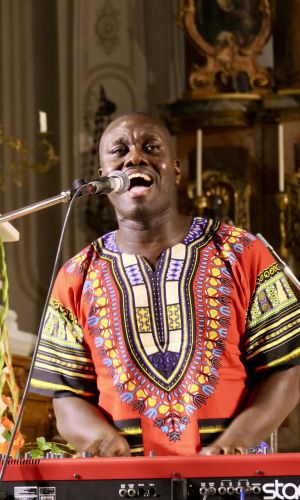
Le Chant sur la Lowé from Gabon, a mixed choir of about thirty members, was founded in 1990. Its mission is to promote high-quality vocal performances beyond the traditional church setting and to reach a secular audience in Gabon and beyond. It also aims to bring Gabon's musical heritage closer to the world by performing a wide range of Gabonese folk songs in all the languages of Gabon. The group's authenticity is reflected in its unique musical pieces, which originate from the heart of the equatorial rainforest, as well as in its costumes, jewelry, and choreography, which draw on Gabon's rich cultural heritage. Le Chant sur la Lowé regularly gives public concerts and various private performances in Gabon. The group has also represented Gabon at several international events, festivals, and competitions abroad.
The Naghash Ensemble from Armenia combines the spirituality of ancient Armenian music with new classical, post-minimalism, and the energy of rock and jazz. Three brilliant singers and virtuoso instrumentalists on duduk, oud, dhol, and grand piano play new music based on the texts of the medieval poet and priest Mkrtich Naghash. The “Songs of Exile,” composed for the Naghash Ensemble by American Armenian John Hodian, form a poignant meditation on the relationship between man and God—from the perspective of a priest who was forced to spend many years in exile. The Musica Sacra International festival also features liturgical chants from the Patarag (the Armenian liturgy), medieval sharakans (sacred hymns), and works by composer Komitas Vardapet, the founder of modern Armenian music. “Sublime music between pride and beauty, sorrow and hope,” wrote the Hamburger Abendblatt, and the BR Klassik review stated: “Music that is difficult to describe as old or new, foreign or familiar, Western or Eastern, simple or complex, minimalist or medieval. In any case, music that defies labeling.”
The State Chamber Choir Polifonija from Šiauliai (Lithuania), under the artistic direction and chief conductor Povilas Vanžodis, is one of Lithuania’s best-known professional choirs. It was founded in 1974 by conductor Sigitas Vaičiulionis for the New Year’s Concert, which has been held annually ever since. Polifonija is the only early music vocal ensemble in Lithuania that performs works by Renaissance and Baroque composers. Initially, it was supported by the Šiauliai Pedagogical Institute, and later by the Šiauliai Conservatory. In 1979, it was awarded the title of national ensemble and the choir was given the name “Polifonija”; in 1986, Polifonija received the status of a professional ensemble and became the State Chamber Choir of the Lithuanian State Philharmonic in Šiauliai. Today, Polifonija is committed to promoting Lithuanian choral music and preserving the tradition of Lithuanian choral art. In its approximately fifty years of existence, the choir has given around 4,000 concerts and toured almost all European countries, as well as Russia, Argentina, and Brazil. It has won prizes at several international competitions.
Prassana Vishnawathan from India (Hinduism). A detailed description will follow shortly.
Structure for the festival period May 22 to 26, 2026. Times are placeholders (??:??).
| Date | Time | Program item |
|---|---|---|
| Fri, 22.05.2026 | ??:?? | Opening concert |
| Sat, 23.05.2026 | ??:?? | Program to follow |
| Sun, 24.05.2026 | ??:?? | Program to follow |
| Mon, 25.05.2026 | ??:?? | Program to follow |
| Tue, 26.05.2026 | ??:?? | Closing concert |
The MODfestivals family consists of:
International festival for sacred choral music. Takes place in even-numbered years.
Renowned competition for chamber choirs. Takes place in odd-numbered years.
Support association for the Marktoberdorf Pentecost festivals and a point of contact for support.
The international choral and music scene meets in the Allgäu at Pentecost.
MOD, the vehicle registration code of the town of Marktoberdorf, is the city’s unofficial abbreviation—it is also the name of the large event center MODEON and of us, MODfestivals!
Marktoberdorf, the district town in the beautiful Allgäu on the edge of the Alps, about 100 km southwest of Munich, becomes the meeting place of the global choral and music scene once a year. Every year over Pentecost, we bring together choirs and ensembles from around the world for musical encounter festivals with the highest international reputation:
In even-numbered years, the encounter festival Musica Sacra International takes place, and in odd-numbered years the International Chamber Choir Competition Marktoberdorf.
The two festivals were founded by Dolf Rabus. It was also his wish that the Bundesvereinigung Deutscher Chorverbände e.V. (BDC) would be the sponsor of the International Chamber Choir Competition Marktoberdorf from its start in 1989 and of the Musica Sacra International festival from 2006 onward. On the initiative of the BDC, the supporting association MODfestivals e.V. was founded on 12 November 2017 and has been responsible for organizing both events since 2018.
Both festivals have become an important part of cultural life in Germany, especially in Bavaria and the Allgäu. They promote, cultivate, and develop choral music at an international level and foster intercultural and interreligious dialogue in line with UNESCO’s guidelines.
The Bundesmusikverband Chor & Orchester e.V. (BMCO), the BDC’s successor organization since 2019, and the supporting association MODfestivals e.V. continue to cultivate the established cultural and political connections and objectives. The BMCO is the ideal patron of both festivals.